
Turquoise Necklace Buying Guide: How to Choose the Right Style
Two turquoise necklaces can look almost identical online yet differ considerably in material, construction, comfort, and price. One may feature natural turquoise, while another uses stabilized, reconstituted, synthetic, or imitation material. Even when the stones are similar, differences in necklace length, bead size, metal, clasp, and overall weight can change how the piece feels once you put it on.
That is why choosing turquoise jewelry based on color alone can lead to disappointment. The necklace may sit lower than expected, feel too heavy for everyday use, or arrive with a stone that does not match the product description.
This turquoise necklace buying guide explains how to compare turquoise types, colors, matrix patterns, necklace lengths, settings, and styles. It will also help you decide whether a beaded strand, choker, pendant, or statement design makes the most sense for your wardrobe and the way you plan to wear it.
What Is a Turquoise Pendant Necklace?
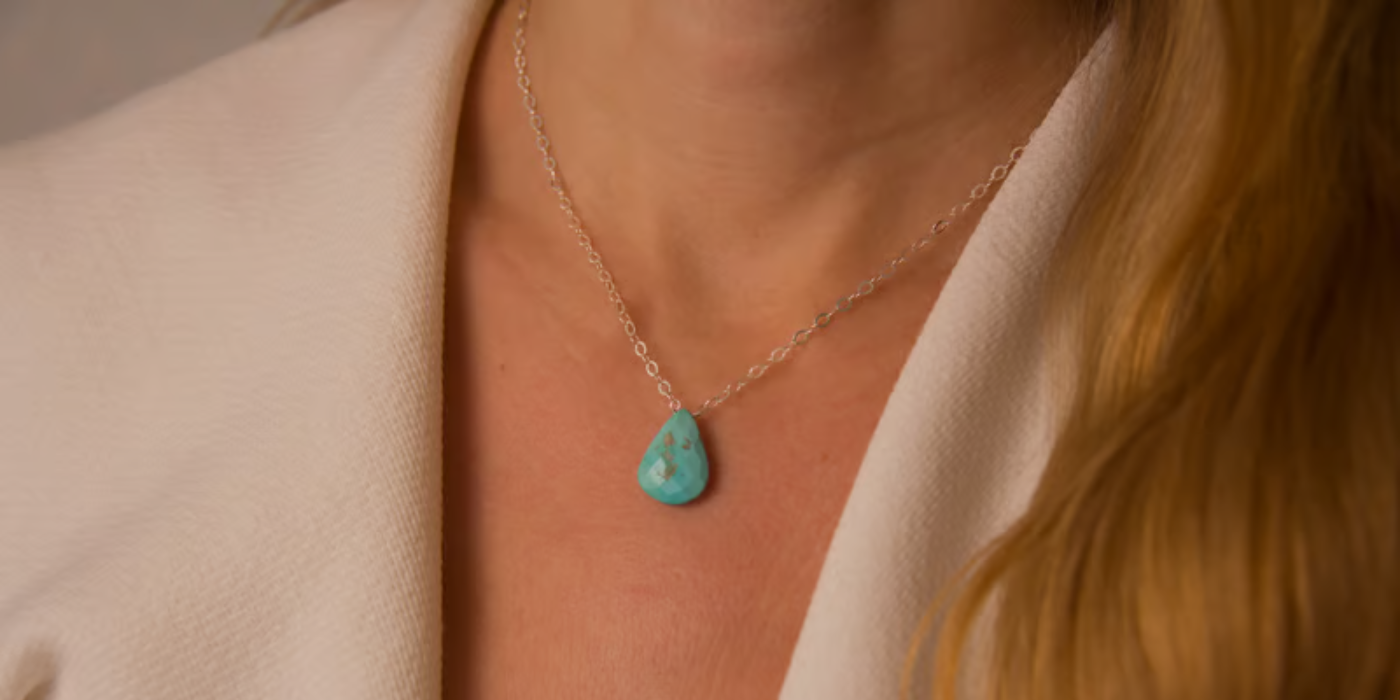
 A turquoise pendant necklace features one or more turquoise stones suspended from a chain, cord, or beaded strand. The stone may be cut into a polished cabochon, carved into a particular shape, or left with a more organic outline. Depending on the design, jewelers may place it in a metal setting or attach it directly to the necklace.
A pendant differs from a fully beaded turquoise necklace because it creates one central point of attention. Small pendants tend to feel subtle and easy to wear, while larger stones make a stronger statement. The chain or cord also affects the final look. Fine metal chains usually create a more polished appearance, while leather cords and beaded strands feel relaxed and earthy.
Turquoise itself occurs in shades ranging from blue to blue-green and green. Some stones have an even color, while others contain brown, black, or golden matrix. Matrix refers to remnants of the host rock in which the turquoise formed. Neither style is automatically better; the right choice depends partly on what appeals to you.
Why Choose a Turquoise Necklace?
Turquoise brings color to an outfit without the intense sparkle associated with many faceted gemstones. Its surface usually has a softer, more organic appearance, which makes it easy to wear with casual clothes as well as more polished outfits.
Here are a few reasons turquoise necklaces remain popular.
The Color Is Easy to Recognize
Turquoise has a distinctive color that stands out even in a small necklace. A delicate strand can brighten a white shirt, neutral dress, or simple sweater without requiring several other accessories.
Blue turquoise often creates a fresh contrast against black, white, tan, and warm brown. Greener shades work especially well with earthy colors, denim, cream, rust, and olive.
Natural Variation Adds Character
Natural turquoise can display differences in color, texture, and matrix. These variations mean stones cut from the same material may still look slightly different from one another.
Variation alone, however, does not prove that a stone is natural. Dyed, reconstituted, synthetic, and imitation materials can also display color changes or manufactured matrix patterns. A trustworthy product description should clearly identify the material and disclose any known treatments.
It Works with Different Jewelry Styles
Turquoise does not belong to one particular look. It can appear in Southwestern-inspired silver jewelry, simple chokers, long bohemian strands, polished gold-toned pieces, or minimalist pendants.
If you prefer quiet everyday jewelry, start with a small stone, slim strand, or short beaded necklace. If you enjoy noticeable accessories, consider larger beads, multiple strands, or a bold central stone.
It Can Be Worn in Different Settings
A simple turquoise necklace can work with a T-shirt and denim during the day, then add color to a plain dress in the evening. Larger designs may suit outdoor celebrations, destination weddings, festivals, or occasions with a relaxed dress code.
The key is proportion. A necklace does not need to be large to be noticeable, especially when the color already contrasts with the outfit.
It Coordinates with Other Natural Stones
Turquoise pairs well with stones and materials that share its natural character. Jasper, amazonite, quartz, lapis lazuli, wood, leather, and warm metal details can all complement it.
If you enjoy building coordinated jewelry combinations, Theory of Beads’ stone bracelet collection includes natural colors and textures that can be worn alongside a turquoise necklace.
How to Choose a Turquoise Necklace
 Learning how to choose a turquoise necklace begins with the material, but it should not end there. Treatment, length, construction, weight, and comfort can matter just as much as the color you first notice.
Ask What Type of Turquoise You Are Buying
Similar-looking necklaces can contain very different materials. Read the product description carefully and look for information about whether the turquoise is natural, stabilized, dyed, reconstituted, synthetic, or imitation.
|
Description |
What It Means |
What to Consider |
|
Natural turquoise |
Turquoise that has been cut and polished without stabilization |
Usually rarer and may require more careful handling |
|
Stabilized turquoise |
Turquoise treated with resin to improve strength |
Common, durable, and practical for regular wear |
|
Dyed turquoise |
Turquoise whose color has been enhanced |
The treatment should be disclosed by the seller |
|
Reconstituted turquoise |
Turquoise particles combined with a binding material |
Usually more affordable than solid natural turquoise |
|
Synthetic turquoise |
Laboratory-created material made to resemble or replicate turquoise |
It should be clearly labeled as synthetic |
|
Imitation turquoise |
Another material made to look like turquoise |
It may include dyed howlite, magnesite, resin, glass, or plastic |
Treatment does not automatically make a necklace a poor choice. Stabilized turquoise can be a practical option because stabilization improves the durability of softer, more porous material. What matters is knowing what you are buying and whether the description and price fairly reflect it.
Evaluate the Color, Matrix, and Surface
Turquoise ranges from blue to blue-green and green. Bright, even blue has traditionally attracted strong demand, but it is not the only attractive option. Some people prefer greener stones or visible matrix because those features give the necklace a more organic appearance.
Look closely at product photographs. Check whether the stones appear smooth and properly finished, and watch for unintended chips, cracks, rough edges, or poorly drilled holes. Matrix is not automatically a defect, just as an even blue surface is not proof of authenticity.
When possible, view several photographs taken in different lighting. Color can look noticeably different under studio lights, daylight, and warm indoor lighting.
Consider the Necklace Style
Each necklace style creates a different effect:
-
A choker sits close to the neck and creates a clean band of color.
-
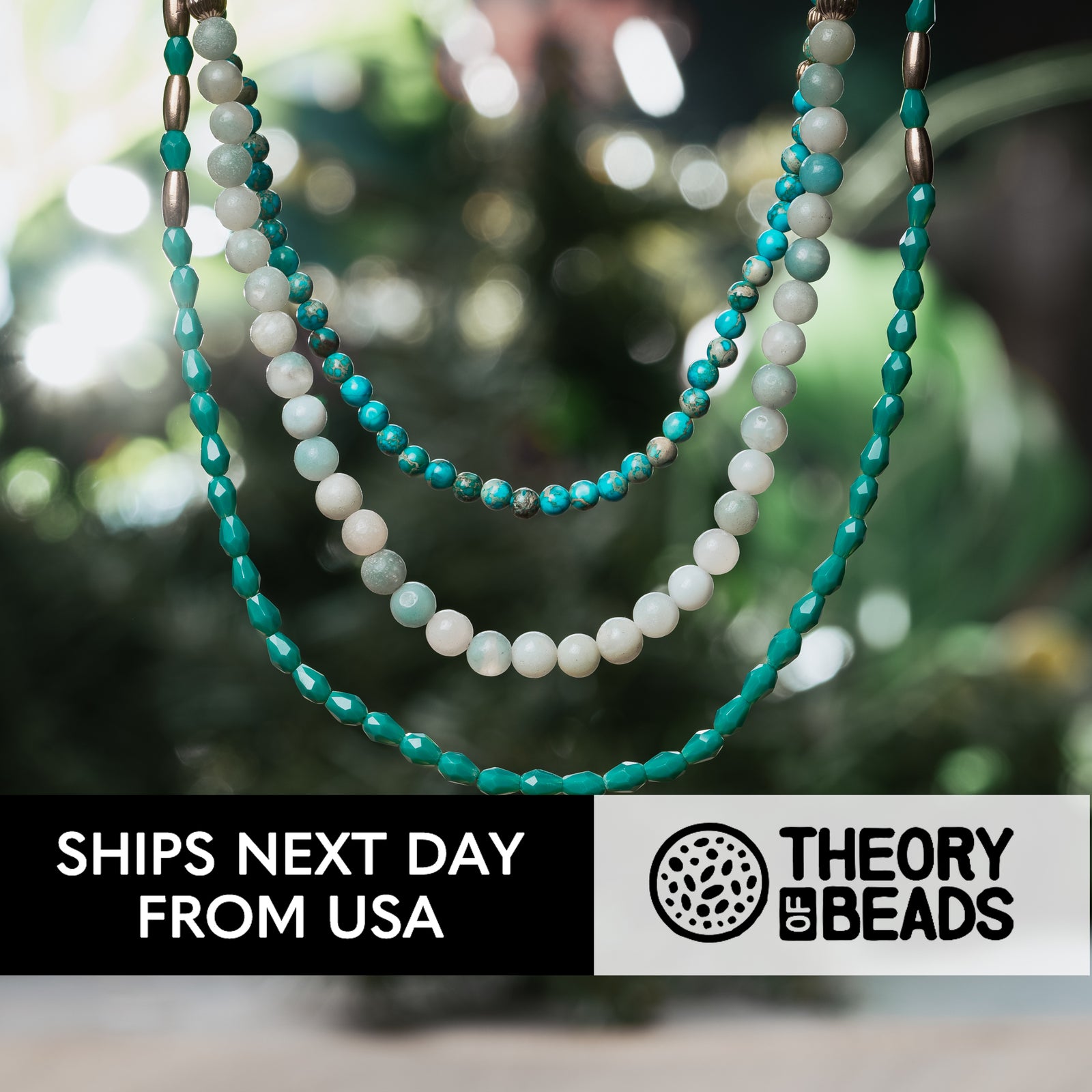
A short beaded strand gives turquoise a larger role without relying on one central stone.
-
A pendant directs attention toward the center of the neckline.
-
A long strand creates a relaxed look and leaves more room for layering.
-
A multi-strand or statement necklace works best when you want the jewelry to lead the outfit.
Browse Theory of Beads’ natural stone necklaces to compare different stone colors, bead arrangements, and necklace shapes.
Choose the Right Length
Necklace length determines where the design sits and which necklines it complements. Do not rely only on photographs. The same necklace may sit differently depending on neck size, body proportions, bead diameter, and pendant dimensions.
|
Approximate Length |
Typical Position |
Often Works Well With |
|
14–16 inches |
At or near the base of the neck |
Open necklines, chokers, and layered looks |
|
18 inches |
Around the collarbone |
Everyday tops, dresses, and smaller pendants |
|
20–24 inches |
Below the collarbone |
High necklines and larger pendants |
|
28 inches or longer |
Upper or lower chest |
Long layers and relaxed bohemian styling |
These measurements are general guidelines rather than universal rules. Check whether the necklace has an extender, and compare the full measurement with a necklace you already own.
If you are unsure, use a piece of string to test the listed length in front of a mirror. This simple step gives you a better sense of where the necklace will sit before you order it.
Check the Metal, Cord, or Setting
 Turquoise may be paired with sterling silver, gold, gold-plated metal, stainless steel, brass, leather, or textile cord. Cool silver tones often create a crisp contrast with blue turquoise. Gold-toned materials produce a warmer appearance, particularly with green-blue stones or brown matrix.
If you have metal sensitivities, look for the complete material description instead of judging the metal by color. “Gold tone,” for example, does not explain the base metal or the type of plating used.
For set stones, inspect the bezel, prongs, jump rings, and connection points. The stone should not shift loosely in its setting. If the necklace uses beads, check that the stringing material and clasp appear strong enough to support their weight.
Think About Weight and Comfort
Weight is easy to overlook when shopping online. Large turquoise beads and oversized pendants may look impressive but can feel uncomfortable after several hours.
For everyday wear, a lighter choker, small pendant, or strand of modestly sized beads may be easier to live with. For occasional use, you may be comfortable choosing something larger.
Also consider texture. Beads with rough edges may irritate the skin, while a heavy pendant can pull a thin chain forward. Product measurements and weight are particularly helpful when photographs make a necklace appear smaller than it is.
Examine the Clasp and Construction
A beautiful stone cannot compensate for weak construction. Check that the clasp closes securely, jump rings are fully closed, and the chain or cord suits the weight of the necklace.
On beaded necklaces, look for even spacing, secure crimps or knots, and neatly finished ends. Individually knotted beads can provide additional security because the entire strand is less likely to scatter if the string breaks.
Also check how the necklace lies in product photographs. Twisting strands, uneven spacing, exposed wire, or loose connection points can indicate rushed construction.
Match the Necklace to Your Wardrobe
Before buying, think about three outfits you could wear with the necklace. If you struggle to name them, the piece may not be as versatile as it first appears.
Short turquoise necklaces work well with open necklines, button-down shirts, and simple dresses. Longer strands can sit over sweaters and high-neck tops. Statement designs usually look best with uncluttered clothing that gives the necklace enough visual space.
For coordinated color without wearing a matching set, consider pairing turquoise with earrings made from another blue or neutral stone. Theory of Beads’ natural stone earrings provide several shapes and colors that can complement a gemstone necklace.
Set a Realistic Budget
Turquoise necklaces are available at many price points. Cost may reflect the type and quality of the turquoise, treatment status, stone size, metal, construction, craftsmanship, origin claims, and seller reputation.
An inexpensive necklace is not necessarily a poor choice. Stabilized turquoise or well-made imitation jewelry may be suitable if the seller describes it honestly and the price reflects the material. Problems arise when imitation, dyed, or reconstituted material is presented as rare untreated turquoise.
Compare specifications rather than relying on appearance alone. If one necklace costs considerably more than similar options, look for a clear reason in the materials, craftsmanship, or documentation.
Read more: How to Use Tila Beads in Bracelets, Necklaces, and Earrings
Turquoise Necklace Buying Guide: Quick Shopping Checklist
Before placing an order, work through this checklist:
-
Confirm whether the turquoise is natural, stabilized, dyed, reconstituted, synthetic, or imitation.
-
Check the complete necklace length, including any extender.
-
Review the size and weight of the beads or pendant.
-
Identify the metal, plating, chain, cord, or stringing material.
-
Look closely at the clasp, jump rings, setting, and connection points.
-
Check whether treatments and material details are clearly disclosed.
-
Read the care instructions.
-
Review the seller’s return, exchange, and repair policies.
-
Consider whether the necklace works with clothing you already own.
-
Look for customer photographs if they are available.
This part of the turquoise necklace buying guide is especially useful when shopping online, where photographs can make scale, color, and weight difficult to judge. If important information is missing, contact the seller before ordering.
How to Find the Best Turquoise Necklace for Women
 The best turquoise necklace for women depends on more than personality. Daily routine, preferred jewelry size, clothing choices, comfort, and the occasions for which the necklace will be worn all influence the decision.
For the Minimalist
Choose a short, simple necklace with small beads or one modest focal stone. Clean construction and restrained proportions will make it easier to wear with work clothes, casual basics, and other delicate jewelry.
Avoid adding too many competing elements. Turquoise already contributes noticeable color, so a simple design can still make an impression.
For the Free Spirit
Look for organic stone shapes, visible matrix, leather details, layered strands, or relaxed beaded designs. These features work naturally with linen, denim, loose dresses, textured fabrics, and other casual pieces.
A longer necklace can provide more styling flexibility, particularly if it can be layered with a shorter strand.
For the Professional
Choose a balanced design that sits neatly around the collarbone. Small beads, a refined clasp, and a manageable weight help the necklace move comfortably from the office to dinner.
Consider how the necklace will work with button-down shirts, blazers, and common work necklines. A design that lies flat is less likely to catch on clothing or shift throughout the day.
For the Confident Statement Maker
Larger stones, contrasting matrix, multiple strands, or oversized focal pieces create greater visual impact. Keep comfort in mind, especially if the necklace will be worn for an entire event.
Statement turquoise usually looks strongest against a simple background. Solid black, cream, navy, or white clothing lets the stone’s color remain the focus.
For the Classic Jewelry Lover
Choose a well-proportioned strand or timeless central stone with clean finishing. Silver provides a traditional contrast, while gold-toned details create warmth.
Rather than following a short-lived trend, focus on secure construction, a useful length, and a design that works with several parts of the wearer’s wardrobe.
Ultimately, the right necklace should suit the wearer’s style, feel comfortable, and come with a clear description of its materials. Those practical details are what turn an attractive purchase into something that gets worn regularly.
Read more: What Is a Mala Necklace and How Do You Use One?
How to Care for a Turquoise Necklace
Turquoise is more sensitive than many harder gemstones. Perfume, lotion, household cleaners, oils, heat, and prolonged moisture can affect its surface or color.
Put the necklace on after applying cosmetics, skincare products, perfume, or hairspray. Remove it before bathing, swimming, exercising, or cleaning. When it needs attention, use warm, mildly soapy water and a soft cloth, then dry it thoroughly.
Do not use steam or ultrasonic cleaners. Avoid soaking the necklace, particularly if it contains porous stones, leather, adhesive, plated metal, or delicate stringing material.
Store turquoise separately from harder gemstones and metal jewelry that could scratch it. A soft pouch or lined compartment helps protect both the stones and the necklace’s construction.
Final Thoughts
A turquoise necklace should offer more than an appealing shade of blue. It should feel comfortable, sit at the right length, suit your wardrobe, and come with an accurate description of its materials.
Before buying, confirm the turquoise type, treatment status, necklace measurements, setting or stringing method, clasp, and care requirements. This turquoise necklace buying guide gives you a practical way to compare those details instead of choosing by appearance alone.
Whether you prefer a close-fitting choker, a beaded strand, or a single pendant, the strongest choice is the one that fits naturally into the way you already dress and live.
Discover Natural Stone Jewelry at Theory of Beads
At Theory of Beads, natural colors, handcrafted details, and California-inspired styling come together in jewelry made for everyday wear. Start with the natural stone necklace collection to compare turquoise and other gemstone designs.
You can also coordinate your necklace with pieces from the stone bracelet collection and natural stone earring collection. If you prefer making your own jewelry, browse the Miyuki Tila beads collection for colors and finishes that can be incorporated into handmade necklaces, bracelets, and earrings.
Review the listed materials, measurements, construction details, and care instructions before ordering. A few minutes spent checking those details can help you choose jewelry you will be comfortable wearing well beyond the first occasion.
Frequently Asked Questions
What should I look for when buying a turquoise necklace?
Check the turquoise type and treatment, color, matrix, surface condition, craftsmanship, necklace length, clasp, setting, and complete material description. A well-made necklace should feel comfortable, secure, and appropriate for the way you plan to wear it.
How can I tell if turquoise is genuine?
You cannot reliably confirm genuine turquoise from color or matrix alone. Dyed, reconstituted, synthetic, and imitation materials can resemble natural stone. Ask whether the turquoise is natural, stabilized, dyed, or reconstituted and look for clear treatment disclosures. For an expensive purchase, consider documentation from a qualified gemologist or laboratory.
Is turquoise suitable for everyday wear?
Yes, but it requires thoughtful care. Cosmetics, chemicals, skin oils, heat, and moisture may affect its appearance. Choose a secure, well-constructed necklace and remove it before bathing, swimming, exercising, or using cleaning products.
What necklace length works best for most people?
An 18-inch necklace is a versatile starting point because it usually sits around the collarbone. The ideal length still depends on neck measurement, body proportions, bead size, pendant dimensions, and the necklines you wear. Always check the exact product measurement.
Does turquoise match every clothing color?
Turquoise works particularly well with white, black, cream, gray, denim, brown, rust, olive, and other earthy shades. It can also complement brighter colors, but keeping the rest of the outfit simple allows the stone to stand out.
Are turquoise necklaces good gifts?
Yes, especially when the recipient already wears blue, green, or natural stone jewelry. Before ordering, check the preferred necklace length, metal color, jewelry size, and whether the recipient usually chooses delicate or statement pieces.
How do I care for a turquoise necklace?
Keep it away from perfume, lotion, household chemicals, excessive heat, and prolonged moisture. Clean it gently with warm, mildly soapy water and a soft cloth, then dry it thoroughly. Never use steam or ultrasonic cleaners, and store the necklace separately from harder jewelry.
How can a turquoise necklace buying guide help me choose the right piece?
A turquoise necklace buying guide helps you compare stone types, treatments, colors, matrix patterns, lengths, settings, construction, and care requirements. Understanding these details makes it easier to identify accurately described jewelry and choose a necklace that fits your needs.